
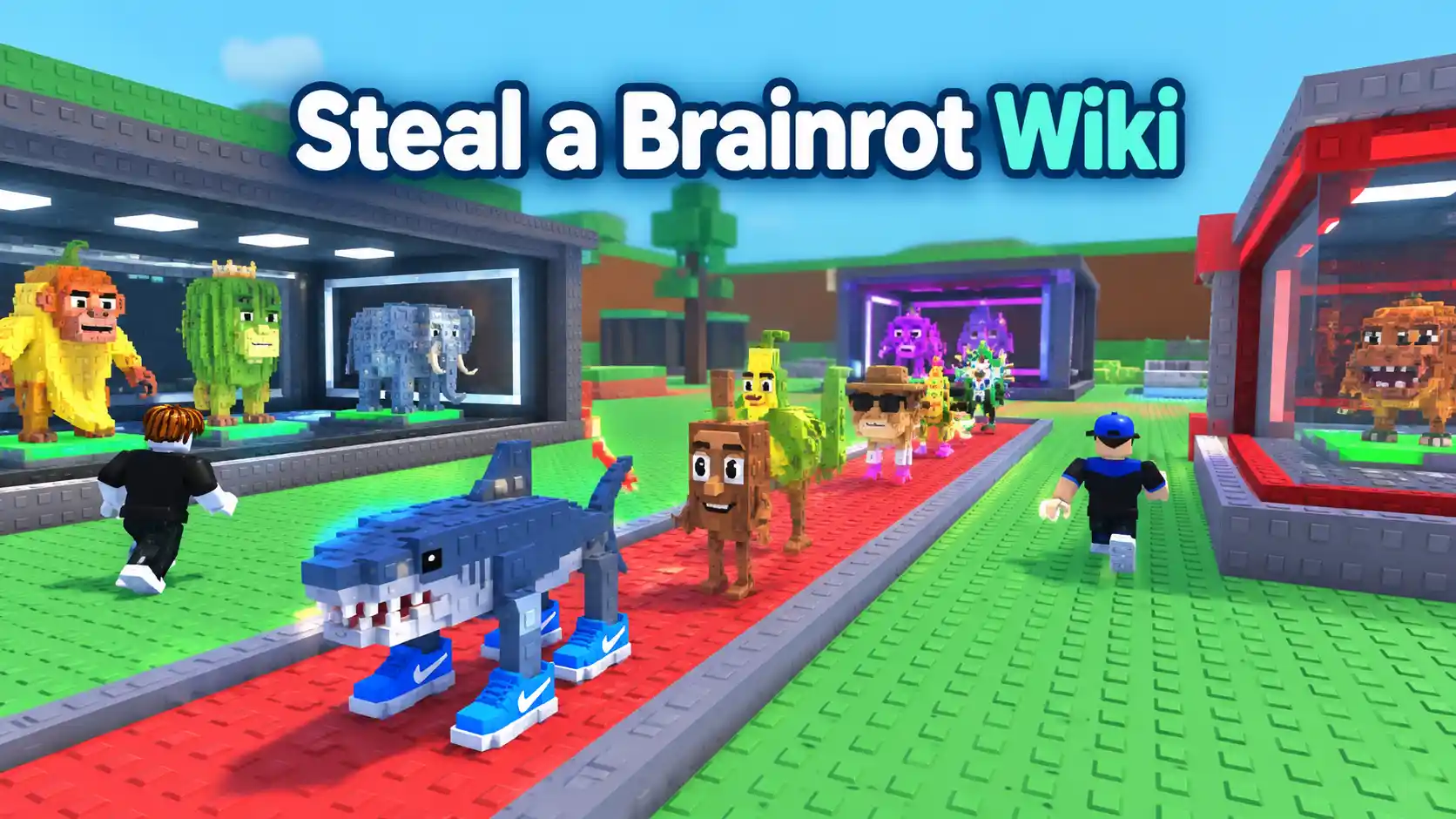

Everything the game doesn’t explain in a tooltip — rarity math, the real Rebirth 19 numbers, what the Grief Shield actually does, and where Update 64’s new Secrets fit into the bigger picture.
Steal a Brainrot is a Roblox game by SpyderSammy and Do Big Studios where you buy, steal, and stack meme-based “Brainrot” characters on a base to generate passive Cash. Rarity runs from Common to OG across eight tiers, income scales with Rebirths (currently capped at Rebirth 19), and the game’s biggest spikes in value come from the developer-hosted Admin Abuse events rather than regular grinding.
How the Game Actually Plays Out
Every session starts the same way: Brainrots spawn on the Red Carpet conveyor, you buy the ones your Cash can afford, and you place them on your base to start generating passive income. That part is simple. What actually separates a serious player from someone who logs in for ten minutes is everything layered on top of it — the fact that anyone on your server can walk into your base and physically carry off your best Brainrot, and that you can do the same to them.
That’s the entire tension the game is built around. A base with no one defending it is free Cash for whoever finds it first. A base that’s too heavily guarded barely gets to steal anything itself. Most of the systems below — Grief Shields, base lock timers, rituals, and the entire rebirth ladder — exist to give that back-and-forth more layers than a straight race to the biggest number.
Worth knowing early: the developer, SpyderSammy, has never published official spawn-rate percentages for anything in this game. Every probability figure floating around — including the ones in this article — comes from large-sample community tracking, not from Do Big Studios directly. Treat numbers as well-tested estimates that can shift after any Saturday update.
Every Rarity, From Common to OG
Eight rarities exist in Steal a Brainrot, and the label tells you how hard something is to find — not what it’s actually worth. That distinction trips up more new traders than anything else in the game, and it’s the reason a full tier list below separates real value from rarity label.
| Rarity | Spawn Rate | Cost Range | Income Range | Guaranteed Window |
|---|---|---|---|---|
| Common | ~55% (most frequent) | $25 – $1.7K | $1/s – $14/s | Constant |
| Rare | Common, slightly less frequent | $2K – $9.7K | $15/s – $75/s | Frequent |
| Epic | Uncommon | $10K – $47.5K | $75/s – $325/s | Frequent |
| Legendary | Low | $50K – $347.5K | $300/s – $1.9K/s | ≥ every 5 min |
| Mythic | Very low | $350K – $6M | $2K/s – $18.5K/s | ≥ every 15 min |
| Brainrot God | Rare | $5M – $76M | $17.5K/s – $317.5K/s | No guarantee |
| Secret | Extremely rare | $50M – $400B | $300K/s – $400M/s | Event/Ritual-dependent |
| OG | Near-zero natural spawn | $450B+ | $450M/s – $1B/s+ | Effectively unobtainable naturally |
Common and Rare exist to teach the base mechanic — most players outgrow both inside their first ten minutes. The “Rare” name is actually a holdover from the game’s early naming scheme; it isn’t rarer than Common in practice, it just spawns marginally less. Epic is where income first becomes meaningful, and Legendary matters beyond raw income because several units in this tier are hard progression gates for early rebirths.
Mythic is where server-wide competition starts to bite — a guaranteed spawn every 15 minutes on a public server means everyone is watching the belt at once. Brainrot God sits above it as a genuine wall: spawn odds drop hard enough that most players get their first one from an event or a ritual rather than pure conveyor luck. Secret has, by far, the widest income spread of any rarity — a $50M Secret and a $400B Secret share a label but nothing else — and OG isn’t really something you farm at all; it’s something you trade, steal, or win.
Where Mutations and Traits Actually Change the Math
Rarity sets the baseline income. Mutations and traits are the multipliers stacked on top, and this is exactly where a lower-rarity Brainrot can genuinely out-earn a rarer one. Mutations are permanent and roll randomly, one per Brainrot, off the conveyor or through stealing:
| Mutation | Income Multiplier |
|---|---|
| Gold | 1.25x |
| Diamond | 1.5x |
| Lava | ~6x |
| Rainbow | 10x |
Rainbow is the one every serious player watches for — it applies to any rarity, meaning a Rainbow-mutated Rare will often out-earn an un-mutated Legendary. Traits work differently: they only apply during specific admin-triggered events (Bombardiro, Tung Tung Attack, Glitch, Crab Rave, and a few others), they stack on top of a mutation rather than replacing it, and they can push a single Brainrot’s output several multiples higher for as long as they’re active. For the full breakdown of every current trait and exactly how each one triggers, Lootester’s Traits Guide goes deeper than fits here.
The Rebirth Ladder & Where Rebirth 19 Sits Right Now
Rebirth 19 is the current ceiling, added with Update 62 on August 15, 2026 — roughly seven months after Rebirth 18 became the previous cap. It’s the steepest single jump the ladder has made in a long time, and it’s the first rebirth to demand a Brainrot earning above $10M per second.
| Rebirth 18 | Rebirth 19 | |
|---|---|---|
| Cash needed | $10Qa | $30Qa |
| Brainrot needed | Graipuss Medussi | La Grande Combinasion |
| Multiplier | x18 | x19 |
| Cash reward | $100T | $250T |
| New item | Flash Teleport | Grief Shield |
La Grande Combinasion — the Secret required for the push — is visually fused from five earlier units (Lirili Larila, Boneca Ambalabu, Tung Tung Tung Sahur, Trippi Troppi, and Tralalero Tralala), wrapped in a glowing white aura that makes it easy to spot on a server. It costs $1B off the conveyor and earns roughly $10M/s, though some trackers log figures closer to $20M/s — treat the higher number as unconfirmed. Don’t confuse it with lookalikes like La Supreme Combinasion or Los Combinasionas; none of those satisfy the requirement.
The fastest realistic path to the $30Qa target isn’t saving toward one mega-purchase — it’s stacking several mid-tier Secrets at once, since a handful of $10–30M/s units will out-earn a single $400B+ Brainrot over the same window without locking you out of income while you save. Lootester’s full Rebirth 19 guide breaks down the farming route, the timing mistakes that cost players their La Grande Combinasion, and how it compares against every rebirth before it.
What the Grief Shield Actually Protects
The Grief Shield is Mythic-tier gear that comes bundled with Rebirth 19, and it’s worth being precise about what it does — because the tooltip undersells it. It doesn’t defend your base. It’s a personal item that absorbs a single hit from a griefer while you’re mid-steal inside someone else’s base, breaking after that one absorption and needing to be replaced.
That makes it most valuable to players who spend a lot of time actively stealing rather than turtling defensively — your base’s own protection still comes down to lock timers and floor placement, not this item. Lootester’s dedicated Grief Shield mechanics breakdown covers exactly what counts as a “hit” and how the absorption triggers, in more depth than fits in a rebirth overview.
Inside an Admin Abuse Session
Regular gameplay is slow — you wait for spawns, save Cash, hope for a lucky pull. Admin Abuse is where that stops applying. It’s a developer-hosted live event where SpyderSammy personally logs in and overrides normal spawn rules: exclusive Brainrots, stacked trait modifiers, Lucky Blocks, and multipliers that simply don’t exist during regular play, all flooding the map at once for 30–45 minutes.
The name is a nod to the classic Roblox meme about admins abusing their powers to mess with players — except here it’s intentional, community-loved, and used to reward them instead. Sessions historically follow a twice-weekly pattern (a Saturday session tied to the content update, and a midweek “Taco Tuesday”), though exact timing shifts often enough that checking the official Steal a Brainrot Discord‘s #bombardiro-news channel beats memorizing a fixed schedule.
Certain Brainrots and traits only exist inside these windows — they don’t spawn through regular play no matter how long you grind. Miss a session and you’re waiting for the rotation to bring a similar spawn back around, which can take weeks. The full Admin Abuse guide covers the themed sub-events (Taco Tuesday, Crab Rave, Galactic events) and exactly how to position yourself before one starts.
The Bee Storyline: How We Got From Update 61 to Update 64
Update 64 isn’t a standalone drop — it’s the fourth beat in a content arc that’s been building since early August 2026:
Introduced the Bee’s Shop, the Queen Bee Event, Honey as a currency, and the RNG Machine, which replaced the old Los Traders system entirely.
Added the Bee Lucky Block, seven honey-themed Brainrots, and new bee gear.
Rounded the arc out with four new Secret Brainrots, the Honey Bee Base skin, and the Bee Admin Machine — covered in full below.
Sir Mangus and the Rest of Update 64’s Secrets
Update 64 went live on August 29, 2026 and shipped four new Secret-rarity Brainrots, a cosmetic base skin, and a machine reskin. It’s a content-and-machine patch rather than a systems overhaul — nothing in the confirmed notes touches trading or gifting, so treat any “new trading system” claim you see elsewhere as unverified.
| Brainrot | Source | Cost | Income |
|---|---|---|---|
| Sir Mangus | Red Carpet | TBA (~$1.2B community estimate, unconfirmed) | $7.5M/s |
| Gub | Red Carpet | $900M | $5M/s |
| Gattino Hydrantino | RNG Machine | TBA | $14.5M/s |
| Puffino Builderino | RNG Machine | $3.7B | $31M/s |
Sir Mangus is the outlier of the four — its wiki entry still shows a generic placeholder image instead of a real render, and its cost field remains TBA. A $1.2B figure has been circulating in the community, but that’s a working estimate, not a confirmed number pulled from the game’s data. Don’t confuse it with Mangolini Parrocini, an older, unrelated Brainrot with a similarly styled name — the mix-up has already caused confusion in a few trading threads. Its income is locked in at $7.5M/s, which already out-earns Gub despite Gub having a confirmed price, making Sir Mangus a genuinely interesting income-to-cost pick if it prices anywhere near Gub once the number goes public.
The update also added a Honey Bee Base cosmetic skin, unlocked by collecting 10 Brainrots (the exact qualifying list isn’t fully published yet), and the Bee Admin Machine — the fifth themed reskin of the game’s hourly event board, following Valentine’s, Divine, Cyber, and Summer versions. It rolls the same Lucky Blocks, Luck Multipliers (up to a genuinely strong 30x), and events as before, just with a honeycomb coat of paint. For the complete breakdown of what’s confirmed versus still unverified, the full Update 64 guide is the most current source.
Where the Tier List Stands Today
A Brainrot’s rarity label tells you how hard it was to get. It doesn’t tell you what it’s actually worth to your base or your trade inventory — three factors do that instead: income-per-cost, current trade demand, and whether it still earns competitively three or four updates from now. Ranked on those factors rather than rarity alone:
Community valuations move fast — sometimes within days of a Saturday update — because fresh Secret and OG units reshuffle demand before the wider trading community settles on a stable price. Always cross-check a specific unit’s current value against a live tracker before committing to a trade; that applies to this list as much as any other. Lootester’s full Tier List & Rarity Guide covers the complete S–D breakdown along with the specific mistakes that cost players real money — like holding a technically-rare unit past the point the market has moved on.
Trading & Why Static Value Lists Go Stale Fast
The in-game cost and income figures published in patch notes are purchase-price fields, not community trade values — plugging Update 64’s numbers straight into a trading calculator as if they were settled WFL (worth-for-list) prices is a common mistake. Real trade value depends on what the community is actually offering right now, which shifts constantly as new Secrets get priced in.
For live, cross-checked values across everything Lootester tracks — not just Steal a Brainrot but Grow a Garden and Grow a Garden 2 as well — the combined value list is kept current the same day trades shift. For the mechanics of the Trading Plaza itself, base skins, and how player-to-player trades actually work in-engine, see the full Trading Guide.
Codes: What’s Actually Redeemable Right Now
Codes in Steal a Brainrot are irregular and usually tied to milestones or announcements rather than a fixed schedule — the fastest way to know what’s live is Lootester’s dedicated codes tracker, which gets updated the same day a new one drops rather than on a weekly batch.