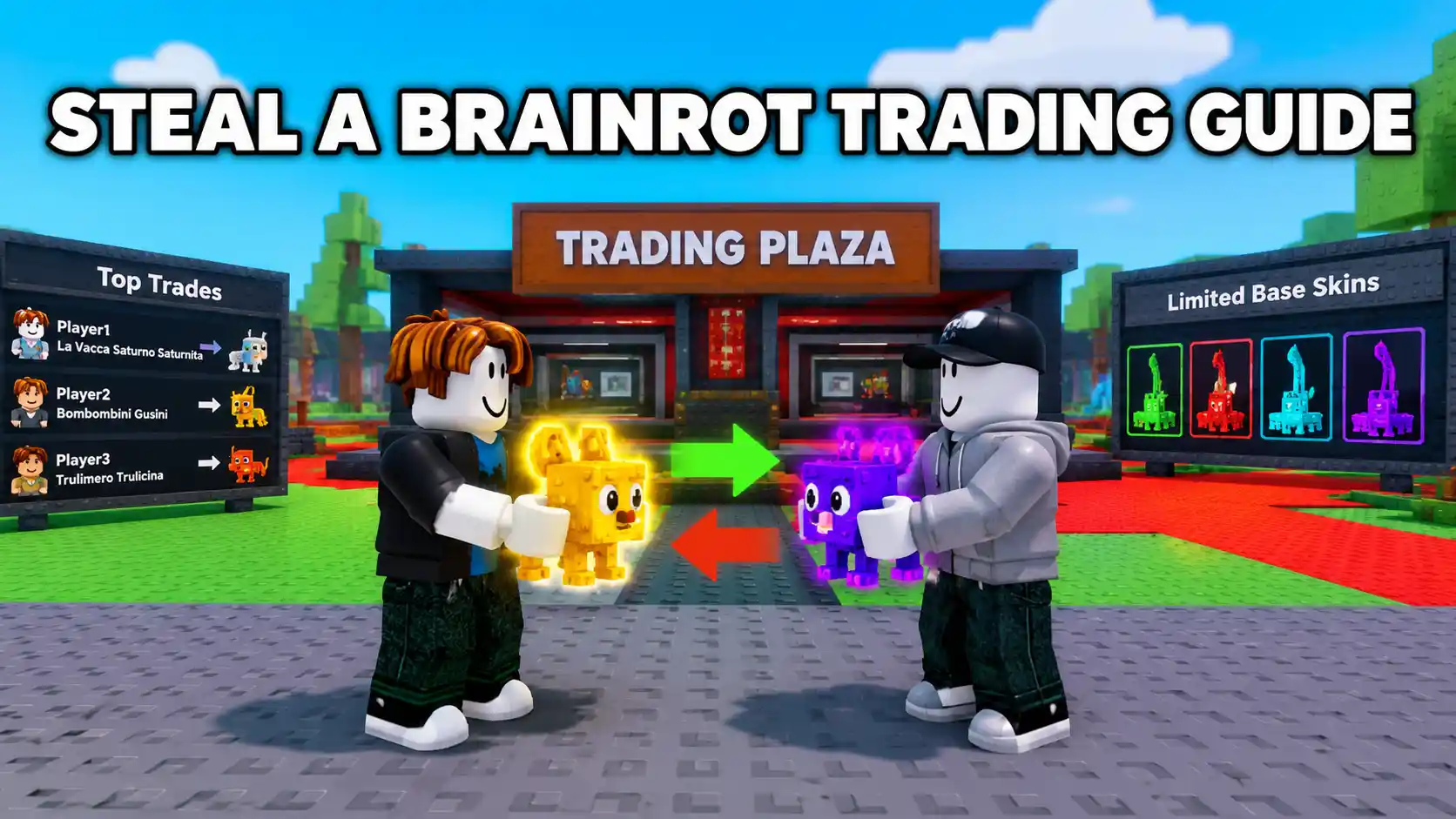

If you logged back into Steal a Brainrot after a few weeks away and suddenly can’t find the old Trade Machine, you’re not losing your mind — it’s genuinely gone. Sammy tore out one of the game’s oldest systems and replaced it with something bigger, messier, and honestly a lot more interesting. Trading isn’t tied to a single spot on the map anymore, base skins are now fair game, and there’s a whole new Trading Plaza where the community actually hangs out to make deals.
This guide walks through exactly how trading works right now, what you can and can’t put on the table, and the specific scam patterns that have already started showing up since the system changed. No guesswork, no recycled 2025 info — just what’s actually live in the game today.
“If you’re still getting used to the basics of buying, defending, and stealing brainrots, our Beginner Guide is worth reading first.”
What Changed With Trading in Steal a Brainrot
Trading in Steal a Brainrot has gone through two major overhauls back-to-back, and it’s worth understanding both because a lot of outdated guides online still describe the old system.
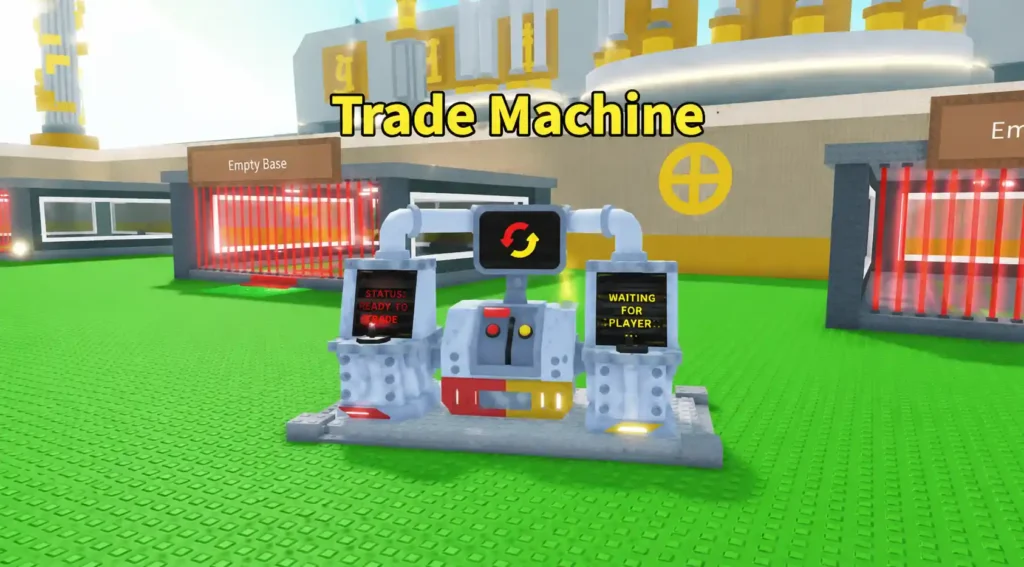
Update 53 (the Summer Update, released June 13, 2026) pulled the old Trade Machine out of the game entirely. In its place, Sammy added a permanent trading interface accessible from a button sitting right next to the Codes menu in the game’s GUI. That single change means you no longer need to walk to a specific tile on the map to trade — you can open a trade offer from wherever you’re standing, whether you’re farming, defending your base, or mid-steal. The empty spot the old machine used to occupy didn’t stay empty for long either; it’s now home to a new RNG Machine that gives players another way to pull brainrots at varying odds. The same Summer Update that also brought the Summer Fuse Machine to the beach event.
Update 54 (Summer Update Part 2, released June 20, 2026) is where the community-facing side of trading really took shape. This update officially launched the Trading Plaza, a dedicated social hub near the Red Carpet where players gather specifically to swap brainrots and base skins face-to-face instead of trading blind with strangers across the server. The same update also turned on live exist counts, so for the first time you can check exactly how many copies of a given brainrot exist in the game directly through the Index — a huge deal for anyone trying to judge whether an offer is actually fair.
One detail worth flagging early: Sammy has confirmed there are no plans to add a token or currency system to trading. Steal a Brainrot’s economy stays strictly barter-based — you’re always trading item-for-item, brainrot-for-brainrot, base skin-for-base skin, never buying or selling through some universal in-game credit.
How to Start a Trade, Step by Step
There are technically two ways to initiate a trade right now, and both use the same underlying interface.
Option 1 — Direct trade from anywhere on the map:
- Find the player you want to trade with. This can be someone already in your server, a friend, or a specific username you send an invite to.
- Tap the trading button in the main GUI, located directly next to the Codes icon.
- Once the other player accepts the invite, the trade window opens for both sides.
Option 2 — Trading through the Trading Plaza:
- Head to the Trading Plaza structure near the Red Carpet.
- Browse or post what you’re offering; this is where most public, stranger-to-stranger trades happen since it’s built specifically for that.
- Once you find a match, the trade opens the same interface as a direct trade.
From here, the process is identical either way:
| Step | What Happens |
| 1 | Each player adds brainrots and/or eligible Seasonal Base Skins to their own side of the trade window |
| 2 | Both sides review the full offer inside the window itself |
| 3 | Each player presses Ready (or Confirm) once satisfied |
| 4 | The trade only executes once both players have confirmed |
| 5 | If either side backs out before both confirmations register, nothing moves and the trade cancels |
The community is still nailing down the exact button labels and click-path as players poke around Update 53’s interface, but this general flow — offer, review, confirm, confirm — is the confirmed core loop.
What You Can (and Can’t) Actually Trade
This is where a lot of players get tripped up, especially with base skins being brand new to the trading pool. Here’s the breakdown as officially confirmed by Sammy:
Tradable:
- Standard brainrots you own, with whatever mutation and traits they currently carry
- Seasonal Base Skins — but only under a specific condition (see below)
Not tradable, no exceptions:
- Brainrot bases and mutation bases — these are permanently locked to your account and cannot be moved through any trade
- Certain fished or event-exclusive “personal prize” brainrots — the game’s trade window will actively block these from being added to an offer
The Seasonal Base Skin rule is the one that catches people out most often. A base skin only becomes tradable once it has left the game — meaning it’s rotated out of the current shop or event and is no longer directly obtainable by new players. Any base skin that’s still actively earnable or purchasable right now stays locked to your account. This is actually good news if you missed out on an older cosmetic like the Cyber base skin before Phantom mutation launched — since it’s no longer obtainable directly, it’s now fair game in trades, giving latecomers a second shot at it. The Red Octo base skin, on the other hand, is a current premium skin bought directly in-game, so don’t expect to see it floating around trade offers just yet.
Mutations, Traits & Why They Matter More Than Ever in Trades
Since Update 53 also introduced the Phantom mutation — currently the strongest multiplier in the game at 12x income — mutation and trait combinations matter more in trade negotiations than they ever have. A base-version brainrot and the same brainrot carrying a high-tier mutation plus stacked traits are, in practical terms, two completely different items, even though they look almost identical on the conveyor belt.
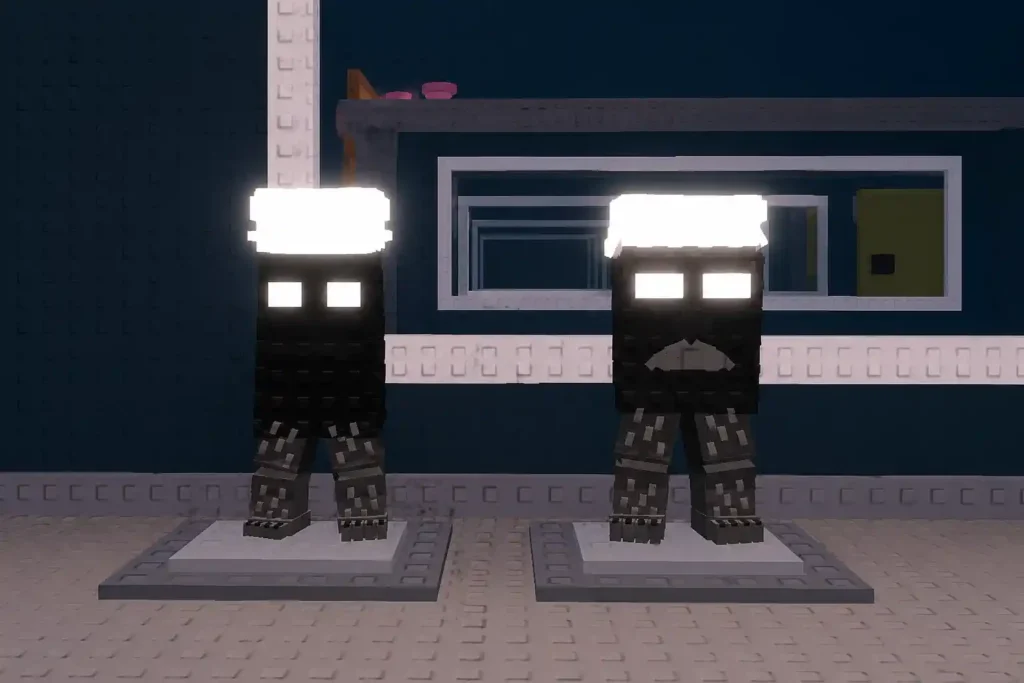
When you’re evaluating any offer, the same brainrot’s name tells you almost nothing on its own. What actually determines value:
- Mutation tier — Phantom currently sits above Rainbow as the strongest permanent multiplier, so a Phantom-mutated brainrot is worth dramatically more than a Default one
- Trait stacking — traits add on top of mutation multipliers rather than replacing them, so a brainrot carrying two or three strong traits alongside a good mutation can outclass a “rarer” brainrot with none
- Exist count — now visible live through the reworked Index since Update 54, this tells you exactly how scarce a specific brainrot really is
- Spawn chance — brainrots that never appear on the Red Carpet conveyor at all are worth holding onto far more tightly than ones you’ll see again within the hour
If you want the full multiplier breakdown for every mutation and trait currently in the game, that’s really a separate deep-dive (worth its own guide), but the short version for trading purposes is: never judge an offer by rarity label alone — always check mutation and trait status before you agree to anything.
How to Spot (and Avoid) Trading Scams
The move away from a single fixed Trade Machine location, combined with base skins now being tradable, has opened up a few new ways for bad trades to slip through. Since there’s no official middleman system or escrow built into the game, every trade still runs entirely on trust once both players hit Ready — which means the responsibility to check things carefully is entirely on you.
Here’s the checklist worth running through on every single trade, no exceptions:
- Verify the trade window, not the chat. A common trick is to describe one offer out loud or in chat, then quietly load a completely different offer into the window right before asking you to confirm. Only trust what’s physically sitting in the trade interface in front of you.
- Watch for last-second item swapping. Because the Ready/Confirm button is the actual point of no return, some players wait until the very last moment to swap an item out, hoping you won’t notice before you confirm.
- Price brainrots and base skins separately. Don’t let a thrown-in base skin be used to justify an otherwise uneven brainrot swap — treat it as a genuine bonus, not a bargaining chip that makes a bad trade “fair.”
- Double-check mutation and traits before accepting, not after. The trade window shows the actual mutated/trait-stacked version of the item, so there’s no excuse for missing this if you actually look.
- Be extra cautious with “fake middleman” setups, especially in the Trading Plaza where you’re often dealing with complete strangers rather than friends. If someone insists a third party needs to “hold” an item before the trade, that’s a major red flag — the in-game trade window is the only mechanism that actually protects both sides.
- Remember there’s no token or credit system. If anyone tries to convince you Steal a Brainrot has some kind of in-game currency or point system for trades, they’re either confused or actively trying to scam you — Sammy has explicitly confirmed trading stays barter-only.
Trading Plaza vs. Direct GUI Trading: Which Should You Use?
| Direct Trade (GUI button) | Trading Plaza | |
| Best for | Trading with friends or people already in your server | Finding new trade partners, browsing public offers |
| Location | Anywhere on the map | Dedicated hub near the Red Carpet |
| Risk level | Lower — usually trading with known players | Higher — mostly strangers, so scam-checking matters more |
| Speed | Instant, no travel needed | Requires visiting the physical location |
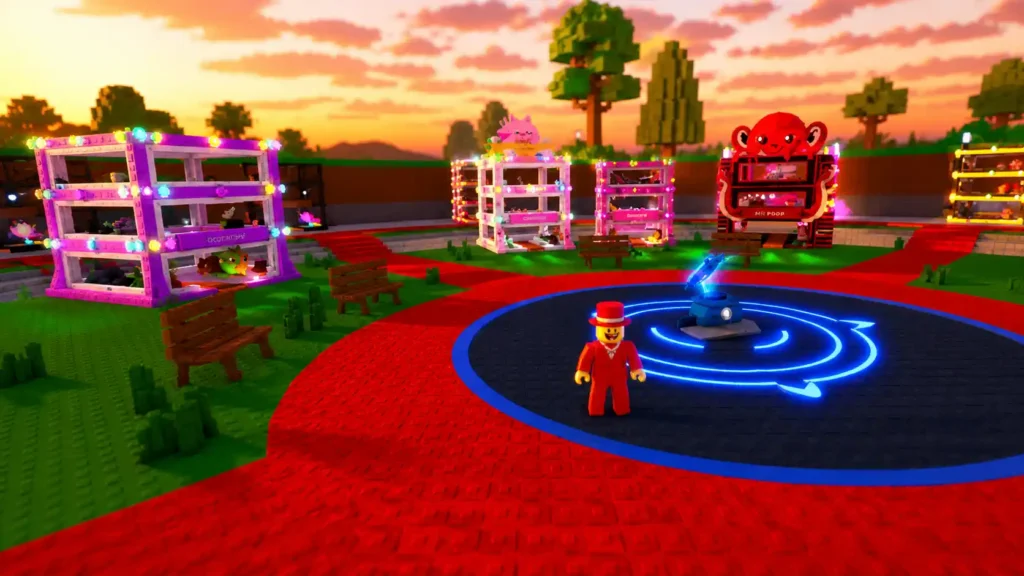
Since its Update 54 launch, community sentiment around the Trading Plaza has actually been pretty positive — a post-launch community poll put satisfaction above 80%, and Sammy has said the space will keep getting refined based on ongoing player feedback rather than being treated as a finished feature.
Frequently Asked Questions
Is there a level or rebirth requirement to use trading in Steal a Brainrot?
No level, rebirth, or progression gate has been confirmed for accessing either direct trading or the Trading Plaza. As far as officially confirmed information goes, trading is open to anyone from the moment they can access the GUI.
If I trade away a Seasonal Base Skin, do I lose it permanently, or does it duplicate?
This hasn’t been officially confirmed by Sammy yet. Until the community verifies exactly how the backend handles this, the safest assumption is that trading a base skin removes it permanently from your account — treat every base skin trade as final.
Will Steal a Brainrot ever add a token or currency system for trading?
Sammy has explicitly ruled this out for the foreseeable future. Player feedback pushed back against the idea over concerns it could destabilize the trading market, so the game stays barter-only — you’re always trading items directly for other items.
Can I trade a brainrot base or a mutation base?
No. Both are permanently locked to your account under the current rules and cannot be included in any trade, whether direct or through the Trading Plaza.
What happened to the old Trade Machine?
It was fully removed with Update 53 on June 13, 2026. The location it used to occupy is now home to the new RNG Machine, and all trading functions moved into the permanent GUI-based system described above.
Final Thoughts
The jump from a single fixed Trade Machine to a permanent, base-skin-inclusive trading system with its own dedicated Plaza is genuinely one of the bigger structural shifts Steal a Brainrot has gone through recently. It opens up a lot more flexibility — no more running across the map just to swap a brainrot — but it also means the burden of catching a bad deal sits entirely with you, since there’s still no built-in escrow or middleman protection. Stick to the trade window over chat promises, always check mutation and trait status before confirming, and treat any base skin you didn’t personally earn firsthand as a permanent, one-way trade.
Since exist counts are now visible live through the Index, that’s genuinely the single best habit to build into your trading routine going forward — check it before every serious trade, not after.
Steal a Brainrot Trader Guide (2026): All Recipes, Values, Spawn Times & Best Trades
Read Guide
Steal a Brainrot Mutations Guide (2026): Full List, Multipliers, Values & Best Mutations
Read Guide
Steal a Brainrot Codes (July 2026): Every Working Code and How to Redeem Them
Read Guide
Steal a Brainrot Tips and Tricks (2026): Ultimate Guide to Stealing Efficiently
Read Guide
Steal a Brainrot Rebirth Guide 2026 (All Requirements, Rewards & Levels)
Read Guide