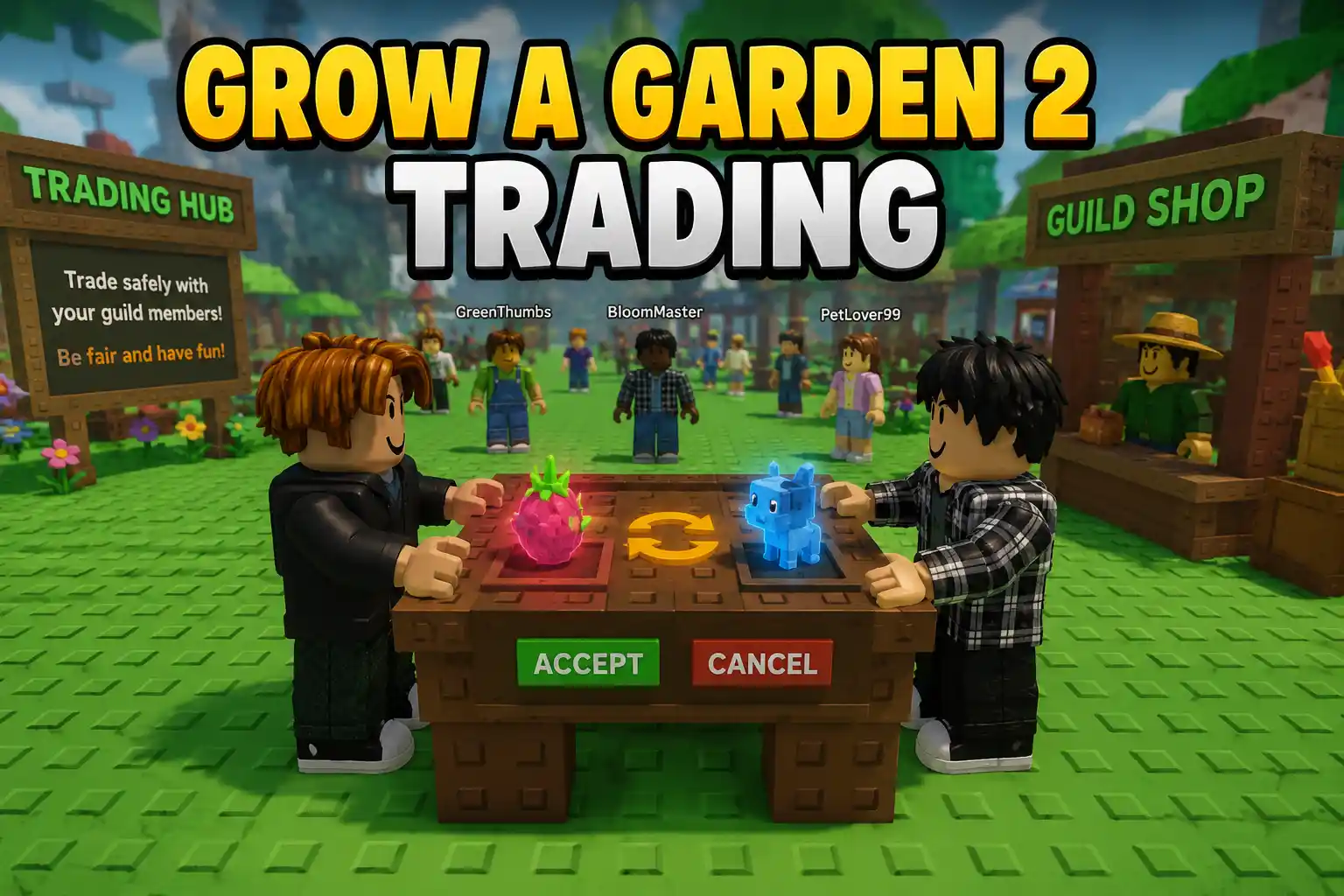

Trading in Grow a Garden 2 currently runs through the guild trading system, added alongside Update 1 in late June 2026. You trade crops, pets, and gear with the members of your own guild — not with random strangers across the whole server. A broader, guild-independent trading window has been reported by some players and community sites, but as of this writing, no official update note confirms an unrestricted trade system open to everyone. Treat anything claiming otherwise as unverified until it shows up in the game’s own patch notes.
If that sounds more restrictive than the free-for-all trading you might remember from the original Grow a Garden, that’s because it is. And once you understand why, the whole system actually makes a lot more sense.
Why Trading Is Guild-Locked
Grow a Garden 2 launched as a standalone sequel on June 12, 2026, and it didn’t ship with player trading on day one. The feature arrived about a week later, bundled into what leakers and early patch coverage called Update 1 — the same update that introduced the guild shop, guild crates, and the traveling trader NPC. Trading wasn’t added as its own standalone system. It was built as a guild benefit, specifically to make coordinated group play more rewarding than grinding solo.
That distinction matters more than it sounds. In the original Grow a Garden, trading was open to anyone who could get another player to agree to a deal. In the sequel, your guild is effectively your trading pool. If you’re not in a guild, or you’re in a small, inactive one, your trading options are limited by design — not by a bug or a restriction you can work around.
A player in the Lootester Discord put it well: “I kept looking for a trade button on my own inventory and couldn’t find one. Turns out you need to be in a guild with someone before it even shows up.” That’s the mechanic working as intended, not a glitch.
Important note on scope: Community sites disagree on how far this goes. Some describe a fully functional in-game trade window — both players load items, both confirm, deal done. Others, checking as recently as mid-July 2026, say they still can't confirm any trading beyond guild members, and flag that broader "summer trading" claims floating around haven't been backed by an official update note. Until the developers confirm otherwise, the safest assumption is: your guild is your trading circle.
How to Get Into a Trading Guild

Since guild membership is the gate to trading at all, this is step one, not an afterthought.
Joining an existing guild costs nothing. You need someone already in a guild to send you an invite, then you accept it through your mailbox — the one sitting right next to your garden plot. Interact with it, open the Mail tab, find the pending invite, and click Join.
Creating your own guild costs 99 Robux, paid to Gilbert, the NPC who runs the Guild Stand in the central hub (right alongside the Sell Stand and Props Shop). There’s no Sheckle-based alternative — it’s a flat Robux fee regardless of how much in-game currency you’ve stacked up.
A few practical ways to find an active, trade-friendly guild if you don’t already have a friend group lined up:
- Global Chat recruitment — plenty of guild owners post openly in the public lobby chat.
- The official Discord server — most active guilds run a recruitment channel.
- Watching public servers — some owners invite players they notice actively farming and contributing.
Before you commit to a guild purely for trading purposes, check its activity level. A 50-member guild where only six people log in regularly won’t give you many trading partners, no matter how big the roster looks on paper.
Step-by-Step: How a Guild Trade Actually Works
The exact trade screen can shift slightly between patches, but the underlying flow follows the same safety pattern every legitimate Roblox trading system uses:
- Both sides agree on the deal in chat first. Spell out exactly what’s being offered on each side before anything gets loaded.
- Open the trade with your guildmate. This happens from within the guild panel, since the system is scoped to guild members rather than any random player you bump into.
- Load your items into the trade window. Each side places what they’ve agreed to hand over.
- Re-read every slot before confirming. This is the single most important habit in the entire guide, and we’ll come back to it in the scams section.
- Both players confirm simultaneously. Nothing moves until both sides lock in — that mutual confirmation step is your built-in safety net.
The system won’t let one side “gift” an item and hope the other person follows through later. If someone’s pushing you toward that kind of one-sided hand-off instead of using the actual trade flow, that’s already a red flag — more on that shortly.
What Actually Makes an Item Valuable
Before you can tell whether a trade is fair, you need to understand what’s driving the number in the first place. Grow a Garden 2’s economy stacks three separate factors, and none of them work the way a first-time trader usually assumes.
Base Value
Every seed, crop, and pet has a starting worth tied to its shop price and rarity tier. This is the number most new players fixate on — and the one that matters least once weight and mutations enter the picture.
Weight
This is the part almost every beginner underrates. A harvested plant’s weight scales its value in a way that heavily rewards outliers. A single oversized, heavy harvest of an ordinary crop can end up worth more than several average-sized harvests of something technically “rarer.” If you’re farming for trade value rather than quick Sheckles, your instinct should be: grow fewer, heavier plants, not more plants overall.
Mutations
Mutations — the visual and value-boosting effects that can land on a crop while it’s growing — stack on top of both base value and weight. A plain-looking crop carrying a strong mutation regularly out-values a “rare” crop with no mutation at all. If you need the full breakdown of every mutation multiplier in the game, that’s covered in detail in the site’s dedicated Mutations Guide.
A quick worked example, using round numbers just to illustrate how these three factors compound rather than add:
Say a common crop has a base value of 10,000 Sheckles. Grown to a heavy weight, that same crop might scale up toward 40,000–50,000 in value purely from size. Add a strong mutation on top, and that number can climb into the hundreds of thousands — all from a crop that looked completely ordinary sitting in the dirt. That’s why judging a trade by “which item looks more special” is exactly the trap that costs new traders the most.
The Win / Fair / Lose Method
Since Grow a Garden 2’s value math isn’t linear, eyeballing a trade is a losing strategy. The trading community has settled on a simple shorthand borrowed from the broader Roblox trading scene: Win, Fair, or Lose (WFL).
| Verdict | What It Means |
| Win | You’re receiving noticeably more total value than you’re giving up. |
| Fair | Both sides land within roughly 10% of each other in total value. |
| Lose | You’re giving up considerably more than you’re getting back. |
Two things to keep in mind here. First, Fair should be your everyday target — chasing a Win on every single trade just means fewer people will deal with you, and word travels fast in a 50-person guild. Second, value alone doesn’t tell the whole story. Demand matters just as much: an item nobody in your guild actually wants is worth less in practice than the raw number suggests, because you can’t easily move it again later. A “fair” trade padded with low-demand filler items is, practically speaking, a quiet loss.
Common Trading Scams (And How to Shut Them Down)
Scams in a guild-locked system look a little different from the open-market scams in other trading games, but the underlying tricks are the same ones that have worked on Roblox players for years.
- Bait-and-switch. Someone agrees to one item in chat, then swaps in something cheaper right before the trade confirms, betting you won’t re-check. Counter: re-read every item in the window immediately before hitting confirm — every single time, no exceptions.
- Inflated self-quoted values. A guildmate insists their item is worth far more than it actually is, hoping you take their word for it. Counter: judge value using the base-value-plus-weight-plus-mutation framework above, not someone’s confident tone.
- Fake rare claims. A completely ordinary pet or crop gets talked up as a limited or “bugged” variant. Counter: verify what the item actually is before agreeing to anything.
- Urgency pressure. “Quick, I need to log off” or “someone else wants this right now.” Counter: a legitimate trade can wait sixty seconds. Pressure is a manipulation tactic, not a real deadline.
- The “gift first, I’ll send mine after” request. This is the oldest scam in any Roblox trading economy, and it’s just as effective in a guild setting where trust is assumed to already exist. Counter: legitimate trades happen simultaneously inside the actual trade flow — never as a one-sided hand-off based on someone’s word, guildmate or not.
If you do get scammed, report the player through Roblox’s own profile menu. You likely won’t get the item back, but a documented report matters for the broader community.
Trading Etiquette That Gets You Better Deals
Trust compounds fast inside a 50-person guild — and so does a bad reputation. A few habits that consistently lead to smoother, more frequent trades:
- Lead with specifics. “Trading my Gold-mutated Tomato for your Deer pet” gets far more responses than a vague “anyone want to trade?”
- Don’t lowball as an opening tactic. It rarely works, and it makes people less willing to deal with you next time.
- Say so plainly if an offer is a Lose for you, and counter with something closer to Fair. Most reasonable guildmates will adjust rather than let the deal die.
- Walk away from anything that feels off. Rushed timing, a mismatch between the chat agreement and the trade window, math that doesn’t add up — any one of these is reason enough to back out. There’s always another trade.
Don’t Confuse Trading With the Auction Stand or the Sell Stall
This trips up a lot of newer players searching for “how to trade” in Grow a Garden 2, so it’s worth clearing up directly. The game has three separate systems that all involve exchanging Sheckles or items, and only one of them is actually player-to-player trading.
| System | Who You’re Dealing With | What It Actually Does |
| Guild Trading | Another player (guild member) | Swap crops, pets, and gear directly with someone in your guild. |
| Auction Stand | The game (NPC, “the Auctioneer”) | A Dutch-style shop where prices start high and drop over time; six rotating items refresh every 30 minutes from a shared, server-wide stock. You’re buying from the game, not another player. |
| Sell Stall (“Steven”) | The game (NPC) | A bargaining minigame where you negotiate a better Sheckle payout when selling your harvest. No items change hands between players here either — it’s purely a better-price mechanic. |
If you’ve been trying to “trade” at the Auction Stand or with Steven at the Sell Stall and wondering why there’s no option to hand off an item to another player, that’s why — neither of those systems involves other players at all.
Frequently Asked Questions
Final Thoughts
Trading in Grow a Garden 2 isn’t the open free-for-all some players expect coming from the original game, and that’s probably by design — tying it to guilds gives the whole system built-in accountability that a stranger-to-stranger trade never has. Find an active guild, learn to price a crop by weight and mutation instead of how flashy it looks, and treat the Win/Fair/Lose framework as your default gut-check before confirming anything.
Keep in mind that this is still a young, fast-moving system. If a wider trading feature does roll out beyond guilds, expect the fundamentals in this guide — value stacking, the WFL method, and basic scam patterns — to still apply. The mechanics change; the way people try to scam you rarely does.
Grow a Garden 2 Value List (July 2026): All Seed & Pet Trading Values
Read Guide
Grow a Garden 2 Mutations Guide: All Mutations, Multipliers & Best Farming Strategies (2026)
Read Guide
Grow a Garden 2 Guilds Guide: How to Create, Join, Manage & Earn Rewards
Read Guide
Grow a Garden 2 Props Guide: Every Crate, Price, Drop Rate & Best Buy Order
Read Guide
How to Make Money Fast in Grow a Garden 2: Best Money Farming Guide
Read Guide