


If you’ve spotted Koala Parabala sitting on the Red Carpet conveyor or in a rival’s base and wondered whether it’s worth the cash, you’re not alone. It’s a Brainrot God-rarity unit in Steal a Brainrot, which puts it a full tier above the Rares and Epics most new players are still farming, but well below the Secret-rarity monsters that dominate the leaderboard. That gap is exactly where most of the confusion lives: is a God-tier brainrot like this one actually worth saving up for, or is it a trap that eats your Cash without paying it back fast enough?
This guide breaks down what’s actually confirmed about Koala Parabala — its rarity placement, how it’s obtained, what mutations do to its income, and how it stacks up against the other Brainrot Gods you’ll see on the same conveyor rotation.
What Rarity Is Koala Parabala?
Koala Parabala sits in the Brainrot God tier, the second-highest rarity band in Steal a Brainrot behind Secret. Brainrot Gods share the conveyor belt with lower-rarity units but spawn far less often, and every unit in this band carries the same rainbow-tinted name effect that flags it as a high-value target the moment it lands in a base.
Right now there are dozens of confirmed Brainrot Gods in rotation, ranging from budget options like Coco Elefanto (around $5M, 10K Cash/s) all the way up to units pulling well over 200K Cash/s. Koala Parabala falls toward the upper-middle of that range rather than the bargain-bin end, which is why it’s worth understanding before you commit a chunk of your bank to it.
Koala Parabala’s Price and Income: What We Actually Know
Here’s where honesty matters more than a clean number. Community trackers currently list Koala Parabala at roughly $35M to purchase, generating around 200,000 Cash per second at base value. That figure lines up with where similarly-priced Brainrot Gods sit on the current earnings tier list, but it’s only been confirmed by a single third-party tracker rather than an official patch note or the in-game stat card, and it happens to overlap almost exactly with the numbers reported for a couple of other Gods released around the same window. That’s not unusual in a game that adds units constantly, but it does mean you shouldn’t treat $35M/200K as gospel.
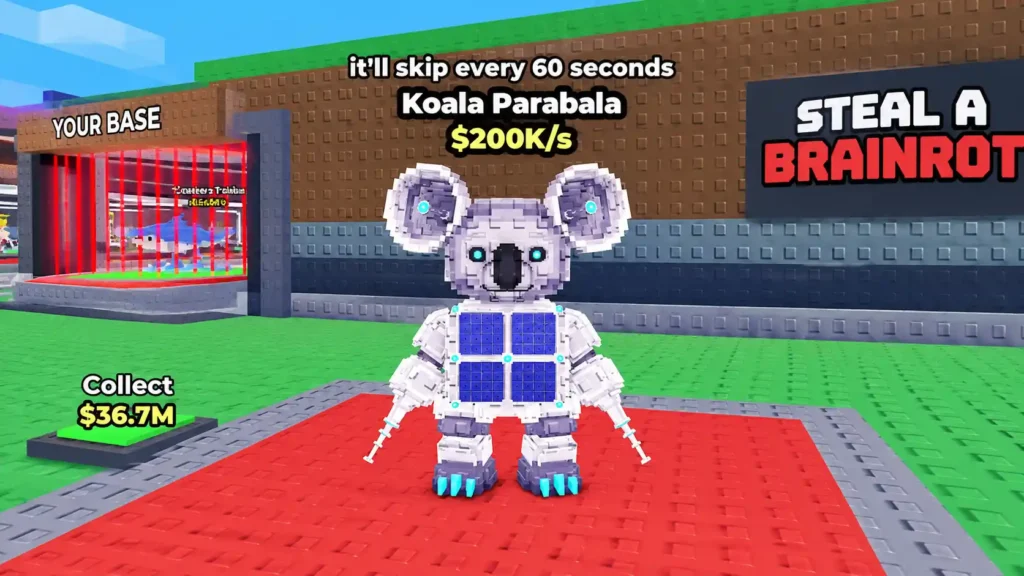
The safest move before you spend real Cash on it: check the live stat card on the conveyor or in the value list the moment you see it spawn. Prices and income rates on newer God-tier units get rebalanced more often than veteran players expect, especially in the weeks right after an admin event pushes a batch of them into wider circulation.
How to Get Koala Parabala in Steal a Brainrot
Brainrot Gods, Koala Parabala included, come through the same handful of doors:
- Conveyor belt purchase. The honest route — wait for it to spawn on the Red Carpet and buy it outright if you’ve got the Cash saved.
- Stealing. Walk into an unlocked base, hold E on the target, and if you make it back to your own base without getting hit, it’s yours. Just remember the owner gets an alert the second you grab it, so speed matters more than stealth here.
- Fuse or Craft Machine. Some Brainrot Gods can be assembled by feeding the right combination of lower-rarity units into the machine rather than gambling on a conveyor spawn. Worth checking the Fuse Machine recipe list if the direct spawn isn’t coming up.
- Brainrot God Lucky Block. Buyable with Robux or occasionally with Cash, this gives you a random God-tier pull rather than a guaranteed Koala Parabala.
- Admin events. Developer-triggered events regularly increase spawn luck for the entire God tier, so logging in during a scheduled event is one of the more efficient ways to see one appear without spending a fortune.
If you’re chasing a guaranteed spawn instead of relying on luck, keep an eye on server like-count milestones — Brainrot Gods are seeded in more reliably once a server crosses certain thresholds, which is also when competition for them spikes.
Does Koala Parabala Get Traits and Mutations?
Yes, and this is where its earning potential actually gets interesting. Like every brainrot in the game, Koala Parabala can roll a single Mutation plus any number of stacking Traits, and the math compounds fast.

Take the unconfirmed 200,000 Cash/s base rate as a working example: a Gold mutation (1.25x) would bump it to roughly 250,000 Cash/s, while a Rainbow mutation — currently one of the strongest permanent mutations in the game at a 10x multiplier — would push the same unit toward 2,000,000 Cash/s. Stack a couple of income Traits on top of that and a “mid-tier” Brainrot God stops looking so mid-tier. That’s the real reason players fight over Brainrot Gods even when a Secret technically outearns them at base value: a mutated God can quietly out-produce an unmutated Secret.
The catch is that mutations aren’t something you can force onto a brainrot you already own — they’re rolled at the moment it spawns on the conveyor, so a Rainbow Koala Parabala is a matter of watching the belt and getting lucky, not something you can farm for.
Is Koala Parabala Worth Buying or Stealing?
For a player who’s already cleared Rebirth 19 and is sitting on tens of millions of idle Cash, a $35M Brainrot God is a reasonable mid-game upgrade — it’s a meaningful step up from Legendary and Mythic units without the eight-figure price tag that Secrets like the ones covered in the game’s wiki demand. For a newer player still working through early rebirths, it’s a bigger gamble: that much Cash tied up in one unit is also that much Cash a coordinated group can steal back in under thirty seconds if your base defenses aren’t ready for it.
Stealing it instead of buying it is cheaper on paper but riskier in practice. You’re relying on finding an unlocked base with Koala Parabala sitting unguarded, and God-tier units almost always attract more attention than common brainrots, meaning the original owner is more likely to be actively watching their base rather than AFK.
How to Protect Koala Parabala From Thieves
Once you’ve got it, keeping it is a separate problem. A God-tier unit sitting in an open base is a magnet, and losing it to a group steal a few minutes after buying it is one of the more common regrets players report. Locking your base the moment you log off, staying near your base during peak-traffic hours, and understanding exactly how the Grief Shield interacts with repeated thefts will save you far more Cash long-term than the marginal difference between one Brainrot God and another.
Some players also intentionally group their higher-value units to qualify for in-game rituals, which can turn a Brainrot God you’re not actively using into a payout instead of a theft target — worth considering if Koala Parabala ends up outclassed by something better before you’ve fully committed to using it as a main earner.
Frequently Asked Questions
Final Verdict
Koala Parabala is a solid, if unremarkable, entry in the Brainrot God tier — not a must-grab unit, but not a wasted purchase either if the price holds around the $35M mark community trackers currently report. Its real value depends almost entirely on what mutation it spawns with, so if you’re buying rather than stealing, it’s worth waiting for a Gold or better roll instead of grabbing the first plain copy that appears on the belt. Treat the exact Cash and income figures in this guide as a starting point rather than a locked number, and confirm them against the live conveyor stat card before you commit a large chunk of your bank.
According to the Steal a Brainrot Fandom Wiki, the game continues to add new Brainrot God and Secret-tier units on a near-weekly basis, so where Koala Parabala ranks today may shift again the next time a batch of units gets rebalanced. Keep checking back for updates as the meta moves.

Complete Brainrot Tier List & Rarity Guide (2026)
Read Guide
How to Unlock Rebirth 19: Requirements & Rewards
Read Guide
Meowl: Real Stats & How to Get One (2026)
Read Guide
Sir Mangus: Price, Income & Everything Confirmed
Read Guide
Steal a Brainrot Codes (Sept 2026): All Active Codes
Read Guide